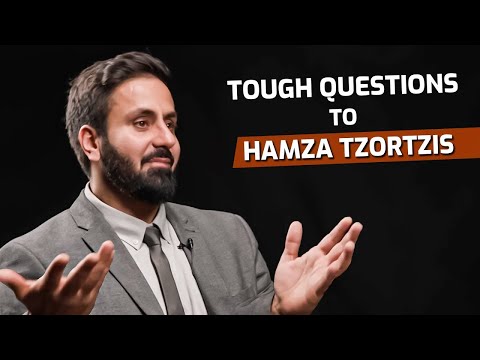
🧠 Tough Questions to Hamza Tzortzis! – The Journey of a Double Convert 🕋
📌 Introduction
Hamza Andreas Tzortzis is one of the most prominent figures in contemporary Islamic thought and dawah (inviting others to Islam). Known for his compelling debates, intellectual clarity, and unapologetic defense of Islam in academic and public circles, Hamza's journey to Islam—and his temporary departure from it—offers profound insights into faith, doubt, and rediscovery. 🙏
🌍 Who Is Hamza Tzortzis?
Born in London to a Greek family, Hamza Tzortzis was raised in a culturally Christian environment but was largely secular in practice. His early life was characterized by material pursuits, hedonistic indulgences, and a strong desire for success in the worldly sense. He was deeply influenced by Western philosophies and was far from any spiritual or religious inclination. 🏛️
As a young man, Hamza was academically inclined, eventually studying at university level where he focused on psychology. During his studies, he began to question the meaning and purpose of life. This intellectual curiosity laid the foundation for his future journey toward Islam. 📚
🕵️♂️ Questioning the Narrative: A Search for Truth
Hamza’s transformation didn’t happen overnight. He was known to challenge religious concepts, ask difficult questions, and often dismissed organized religion. But these challenges weren’t shallow—they were grounded in real philosophical inquiry. He began reading Islamic texts, listening to lectures, and engaging in deep discussions with Muslims.
What amazed him most was the consistency of the Qur’an’s message, its rational coherence, and its alignment with many of the philosophical and ethical ideas he had been contemplating. He was particularly impressed by the Qur’anic emphasis on monotheism, accountability, and morality. 🌙✨
📿 Embracing Islam
Eventually, Hamza found the answers he had been searching for in the message of Islam. He converted and quickly became one of the most prominent English-speaking Muslim apologists in the world. He joined the Islamic Education and Research Academy (iERA) and delivered lectures around the globe. 🕌
What set Hamza apart was his ability to speak the language of secular and academic audiences. Whether debating leading atheists like Lawrence Krauss or speaking at universities across Europe and North America, he presented Islam not as dogma, but as a rational and compelling worldview. 🎓
🧩 The Crisis of Faith: A Moment of Doubt
In 2016, Hamza surprised many by stepping away from the public dawah scene. He released a public statement explaining that he was going through a spiritual crisis and needed time to reassess his faith. This admission shocked many of his followers and critics alike.
But this wasn’t the end of the road—it was a moment of deep self-reflection. Instead of pretending everything was fine, Hamza bravely acknowledged his internal struggles and stepped back to reevaluate his beliefs without the pressures of public life. 🤯
🔄 Return to Islam: A Second Embrace
After a period of introspection, reading, and scholarly engagement, Hamza returned to Islam with a renewed conviction. He described this period as the most transformative in his life. His second “conversion” wasn’t about becoming a Muslim again in the literal sense, but rather about re-entering the faith with deeper understanding, sincerity, and humility. 💫
He shared that doubt is not the enemy of faith; unchecked arrogance and blind following are. His message evolved to be more nuanced, compassionate, and focused on the heart as much as the mind. ❤️🧠
🗣️ Debates with Famous Atheists
Hamza Tzortzis became internationally known for his high-profile debates with leading atheists, including Professor Lawrence Krauss, Peter Atkins, and other prominent figures. In these engagements, Hamza masterfully defended Islam using logic, ethics, metaphysics, and science.
His debates were not hostile but rather intellectually rigorous. He emphasized mutual respect, rational discourse, and the pursuit of truth. For many, these dialogues opened their minds to the possibility that Islam is not only spiritual but deeply intellectual. 🧬📖
🎤 Reformed Message: The Power of Compassion
In recent years, Hamza has taken a more holistic approach to dawah. He now emphasizes the importance of emotional intelligence, inner peace, and love. While he still values reason and academic rigor, he believes that hearts must be reached before minds. 💖
Through his book "The Divine Reality: God, Islam & The Mirage of Atheism", he laid out a modern, philosophical defense of belief in God and Islam’s message. The book has become a cornerstone for many young Muslims and seekers of truth. 📘
👨👩👧👦 Family and Personal Life
Hamza is also a family man. His spiritual growth has influenced how he raises his children and interacts with society. He shares insights from his personal journey, reminding others that faith is not linear—it’s a relationship with God that requires constant renewal and self-reflection. 🧕👨👧👦
⚖️ On Islamophobia and Misconceptions
Hamza has also spoken extensively on the rising tide of Islamophobia in the West. He advocates for better representation of Muslims in media, education, and politics. Through his speeches, he highlights the beauty of Islamic values such as justice, mercy, and community. 🕊️
He believes that by living Islam authentically and engaging constructively with society, Muslims can change hearts and perceptions. His advice to young Muslims is simple but powerful: Know your faith, live it with excellence, and share it with wisdom. 🌟
🧭 Final Thoughts: A Journey of Transformation
Hamza Tzortzis’s journey is one of profound transformation. From skepticism to belief, from preaching to pausing, from doubt to conviction—his life is a testimony to the depth and resilience of sincere spiritual search.
He reminds us all that faith is not a static identity but a dynamic process. That even those who preach it can falter, and that coming back—stronger and humbler—is not weakness but strength. 💪
In a world often caught between extremism and secularism, Hamza Tzortzis offers a balanced, reflective, and deeply human approach to religion. Through his experiences, debates, writings, and talks, he continues to inspire thousands to seek truth with both heart and mind. 🧭📿✨
Comments
Post a Comment